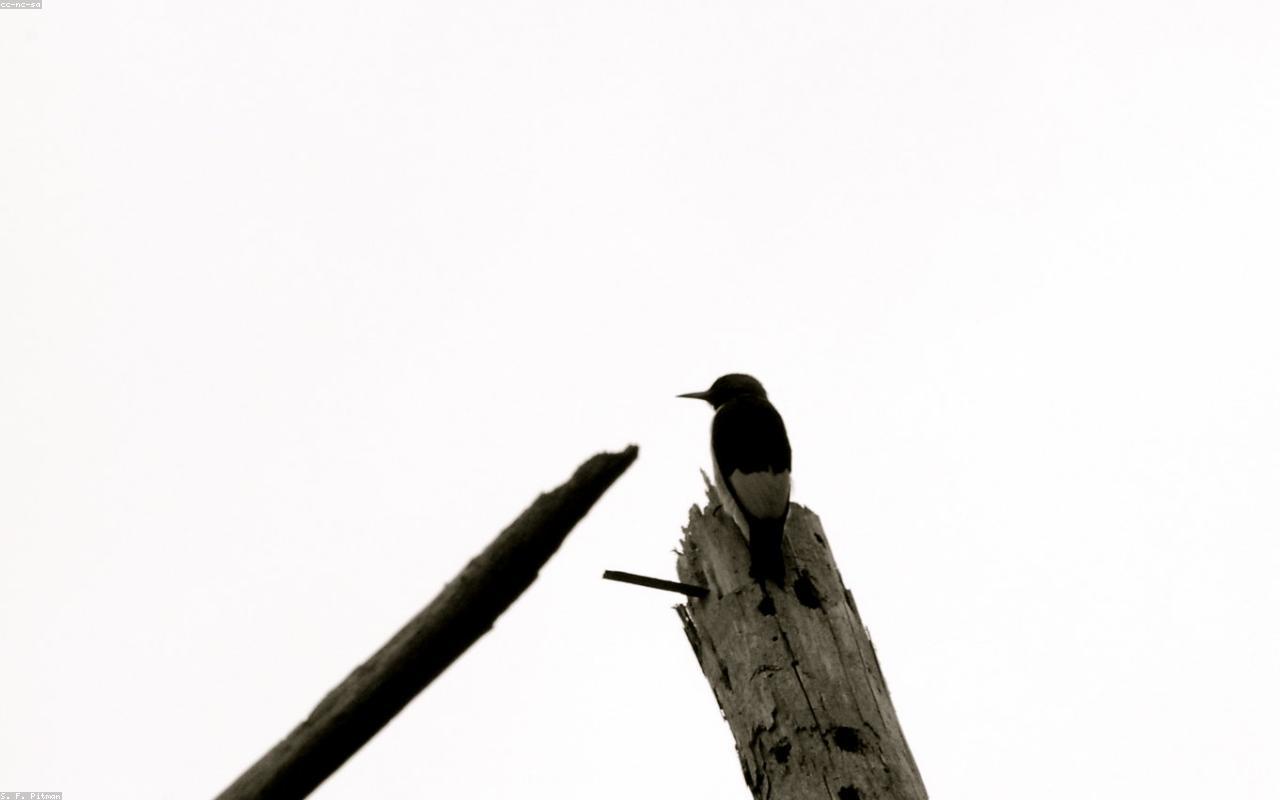
At Carolina Sandhills National Wildlife Refuge in McBee, South Carolina, in early May, a family group of five red-cockaded woodpeckers worked four cavity trees within a hectare. The youngest helper bird at the cluster was a male hatched in 2024. The breeding female was at least nine years old.
Red-cockaded woodpeckers (Dryobates borealis) are small black-and-white woodpeckers endemic to mature longleaf pine forests of the southeastern United States. They are obligate cavity excavators in living pines, which is unusual: most other cavity-nesting birds use dead trees or natural cavities. The work of excavating a living pine takes years.
And they are cooperative breeders. Adult males other than the breeding pair stay at the cluster as helpers — feeding nestlings, defending the territory, maintaining cavities. The system is one of the best-studied examples of cooperative breeding in North American birds.
It is also a species whose recovery, like that of Kirtland's warbler, has required a level of long-term intervention that complicates any simple narrative of restoration.
Longleaf pine (Pinus palustris) once dominated roughly 90 million acres of the coastal plain from Virginia to east Texas. By the late twentieth century, the ecosystem had been reduced to perhaps 3 million acres by logging, agricultural conversion, and the suppression of the frequent low-intensity fires the longleaf community depends on. The red-cockaded woodpecker contracted with its habitat.
The species was federally listed as Endangered in 1970. By 1990, the rangewide population was estimated at perhaps 4,500 family groups. By 2024, the figure had climbed to roughly 7,800 active clusters, sufficient to support a 2024 reclassification from Endangered to Threatened. The reclassification was contested by some conservation groups, which argued that ongoing management remained essential and that downlisting risked political pressure to reduce that management.
Carolina Sandhills NWR is one of the recovery's anchor populations. The refuge holds roughly 130 active clusters across 47,000 acres of mostly upland sandhill habitat. Refuge staff conduct prescribed burns on a two-to-four-year rotation across most of the property. The fires keep the longleaf understory open and prevent the encroachment of hardwood species — primarily turkey oak and post oak — that would otherwise crowd out the pines and degrade woodpecker foraging habitat.
On the morning of May 7, refuge biologist Maria Esposito met this writer at a cluster designated CS-114, walking distance from a gravel access road. The cluster's four active cavity trees had been excavated, respectively, in 1996, 2001, 2014, and 2019. The 2019 tree had been an artificial cavity, installed by refuge staff using a chainsaw-cut starter cavity that the woodpeckers then completed.
Artificial cavity installation has been one of the recovery program's signature interventions. Because a natural cavity in living longleaf can take a woodpecker family three to seven years to excavate, the lag between population growth and habitat availability had become a recovery bottleneck. The Carter and Walters team at North Carolina State University developed and refined the technique in the 1990s. It is now standard practice across the species' range.
Esposito pointed out the resin wells around the entrance of the 1996 cavity. Red-cockaded woodpeckers maintain these wells — small holes drilled into the bark above and below the cavity — to make sap run down the trunk. The sap creates a barrier that deters tree-climbing rat snakes, which are the species' principal nest predator. A cavity in a longleaf without active resin wells is, within a season or two, no longer usable.
The five birds at CS-114 included the breeding pair, two adult male helpers (one from 2023 and one from 2024), and a juvenile from the 2025 clutch that had not yet dispersed. The 2025 juvenile would, statistically, either stay as a helper, attempt to disperse to a vacant breeding position elsewhere in the refuge, or die in the attempt. Dispersal mortality in red-cockaded woodpeckers is substantial.
The female of the pair was banded as a nestling in 2017 at a cluster three kilometres west. She moved to CS-114 in 2019 after the previous female there died. She has produced fledglings in five of her seven seasons as breeder at this cluster, totalling, by Esposito's count, fourteen birds. Two of those fourteen are now breeders at other clusters on the refuge. One is the breeding male at a cluster sixty kilometres south on a private property enrolled in the Safe Harbor program. The fates of the remaining eleven are mostly unknown.
The Safe Harbor program is one of the under-discussed mechanisms behind the recovery. Private landowners with red-cockaded woodpecker habitat have, historically, been incentivized to avoid managing for the species because the ESA's regulatory protections could constrain land use. The Safe Harbor program, developed in the 1990s, allows private landowners to enroll their properties in voluntary conservation agreements that fix the baseline regulatory obligation at the time of enrollment. Any additional woodpeckers attracted by improved management can be legally relocated or otherwise managed without triggering new constraints.
It is, in environmental-policy terms, a creative compromise. It has measurably increased the amount of working private timberland actively managed for the species. As of 2025, more than 250,000 acres were enrolled.
Whether the recovery model — heavy public investment in burns and cavity work, plus regulatory creativity on private land — can be sustained indefinitely is the open question. The downlisting decision suggested that the Fish and Wildlife Service believes it can. Critics suggested that the political environment for sustained federal forestry investment is more fragile than the agency assumes.
Esposito did not engage the politics. She did note, walking out of the cluster at 9:40 a.m., that the species had been moving in the right direction for thirty-five years and that this was not, in conservation biology, common.
The birds at CS-114, indifferent to all of this, continued foraging up the trunks of the surrounding pines, scaling bark for the small beetles and ants that make up most of their diet. The breeding male flew to the 2014 cavity at 10:02 a.m. to deliver an insect to nestlings whose voices were audible from the base of the tree. The cluster was, by the simple measure that matters most, working.