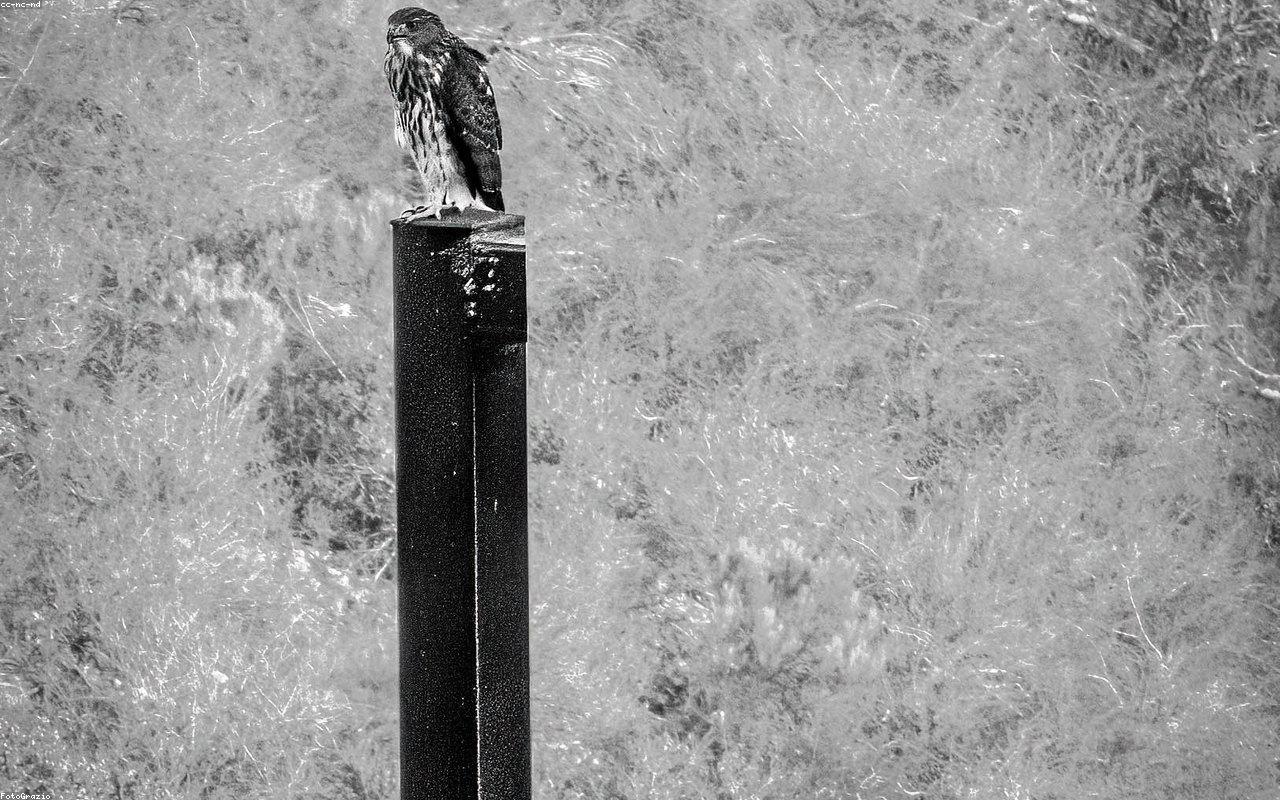
The tui in the kowhai tree above the lower track at Zealandia, on the morning of the fourth of June, produced a sequence of clicks, whistles, gulps, and what sounded like a coin being dropped on a tile floor. It did this for forty seconds and then went silent.
Jasper Wynn was twenty metres downhill with a recorder running. What he caught on the audible side was distinctive enough to be identifiable as tui. What he caught when he later examined the spectrograph was more interesting.
The tui, Prosthemadera novaeseelandiae, is a medium-sized New Zealand honeyeater. It is black with a white throat tuft, a curved bill, and a song repertoire that is among the most acoustically complex of any songbird in the world.
Part of that repertoire is above the upper limit of normal human hearing.
The tui produces vocalizations across a wide frequency range, from below one kilohertz to above twelve. Some of the upper-frequency components are inaudible to most adult human ears, which lose sensitivity above about ten kilohertz with age.
The function of the ultrasonic component is not fully understood. The receivers are presumably other tui, whose hearing extends higher than ours. The communicative content may include individual identity, alarm signals, or simple territorial advertisement at frequencies that carry differently through dense forest.
Wynn's recordings, made at Zealandia over three mornings in early June, show the upper-frequency components clearly. They are not loud, but they are consistent across the recorded individuals.
Zealandia is a 225-hectare sanctuary in the hills above central Wellington, enclosed by a 8.6-kilometre predator-proof fence completed in 1999. Inside the fence, introduced mammalian predators have been eradicated. The bird populations have responded.
The tui inside the fence are at densities not seen on mainland New Zealand since the late nineteenth century. They are also, by the observations of the Zealandia rangers, vocally more elaborate than tui in unprotected habitat elsewhere in the country.
This is an unfalsifiable observation in any rigorous sense. There is no controlled comparison. But the qualitative point is hard to miss. A morning at Zealandia is noisier than a morning in equivalent forest outside the fence.
Part of the noise is sheer density. There are more birds. Part of it may be relaxed selection on cryptic behaviour, since the predators that historically penalized loud vocalization at the nest have been removed.
Wynn is cautious about this hypothesis. He is more comfortable describing what he heard than explaining it.
What he heard, in three mornings of recording, was the following. Every tui he recorded produced both audible and ultrasonic components. The audible components varied widely across individuals. The ultrasonic components also varied but in ways that, to the recording equipment, looked patterned.
He recorded six individual tui at three different perch areas. Each had a recognizable signature, in both the audible and the ultrasonic range.
The mechanical sounds, the click-and-gulp components, were present in all six. These are produced by the tui's specialized syrinx, which has unusual musculature that allows for very rapid switching between sound types.
The audible whistles were the most varied. One individual, at the upper sanctuary near the old reservoir dam, produced a phrase that was strongly reminiscent of a bellbird's song. Bellbirds are present in the sanctuary, and cross-species mimicry has been documented in tui.
Another individual, lower down near the lake, produced a sound that was, unmistakably, a passable rendition of a tui call broken by a long pause and then a short electronic-sounding beep. The beep was at the same frequency as the closing-time announcement played over the sanctuary's loudspeakers.
Whether this is mimicry of the loudspeaker is impossible to confirm. It is plausible. Tui in urban Wellington have been observed mimicking car alarms, mobile phones, and the calls of other birds they have heard repeatedly.
What Zealandia offers, more than mainland New Zealand can, is the chance to hear the species roughly as it would have been heard before the European introduction of stoats, rats, and possums in the nineteenth century.
The tui was never extirpated from the mainland, but its populations were thinned and its behaviour likely changed. Inside the fence, the older condition has, to some extent, been restored.
For the visiting birder, Zealandia is one of the most rewarding morning walks in the southern hemisphere. The entrance is a kilometre from central Wellington. The track is well-graded. The birds are loud and visible.
Wynn's recordings will be deposited with the Department of Conservation's acoustic archive and with the Macaulay Library at Cornell. The ultrasonic components will be of particular interest to the small community of researchers working on the upper-frequency communication of the New Zealand honeyeaters.
For the rest of us, the morning is enough. A bird in a tree producing a sound that, in part, we are not even hearing. The world is larger than the band we listen on.