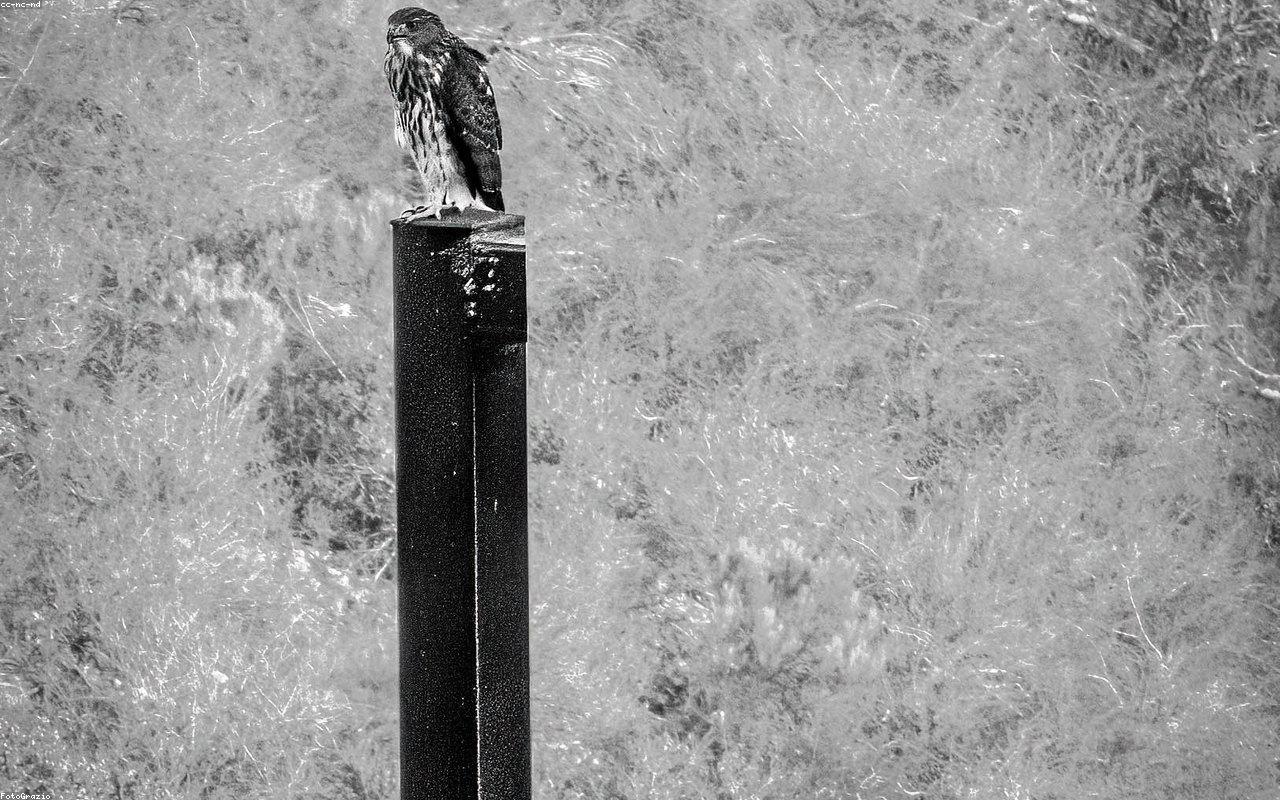
A male Veery, Catharus fuscescens, sang at 19:38 on the seventeenth of May from a wet hemlock slope in the Catskill Forest Preserve. Jasper Wynn was on a log about forty metres downhill with a Sound Devices MixPre-6 and a parabolic dish.
The song is one of the more arresting in the North American repertoire. It descends in a spiralling, almost circular gesture, the notes blurred at the edges, as if the bird were singing into a glass.
This blurring is not an artifact of the listener's ear or the recording. It is built into the song.
The avian syrinx, unlike the human larynx, is a bilateral organ. It has two sides, each with its own membrane and muscle complex, each capable of producing sound independently.
In most songbirds, the two sides are used sequentially or in close coordination, producing what sounds like a single voice. In a few species, they are used simultaneously, producing two pitches at once.
The Veery is the textbook North American example.
Donald Borror published the first careful analysis in 1961, from sonograms of recordings made in New Hampshire. He showed that the apparent blur in the Veery's song was the result of two overlapping pitches, typically a fundamental and a harmonic-related upper note, sung simultaneously from the left and right halves of the syrinx.
The two pitches are not in arbitrary relation. They are usually offset by an interval close to a perfect fifth or perfect fourth. The result, to a human ear, is a chord-like blur rather than a clean tone.
Wynn's recording on the Catskill slope shows this clearly when slowed and run through a spectrograph. Each phrase of the song is two parallel lines on the display, the upper one slightly fainter, the lower one carrying most of the energy.
The lower line is roughly the fundamental. The upper line is the harmonically related second voice from the opposite side of the syrinx. Together they produce what no single voice could.
The Veery is not the only species with this trick. The Wood Thrush uses both sides of its syrinx simultaneously in the closing phrases of its song. The Brown Thrasher does something similar in some phrase types.
What makes the Veery distinctive is that the two-voice phenomenon shapes the entire song, not just one phrase. The blurred, glassy quality is the song.
Marius Doyle has written, in this magazine, about the hermit thrush's preference for harmonic intervals. The Veery's case is related but different. The hermit thrush chooses intervals between successive notes. The Veery sings two pitches at the same moment.
What this means for the bird's behaviour is not fully worked out. The simultaneous two-voice singing requires precise neural control of both syrinx halves. It is, biomechanically, a more demanding song than the hermit thrush's.
Female Veeries may be selecting, in part, for that demonstrated control. There is some evidence that song complexity and bilateral coordination are honest signals of male condition, though the evidence in this particular species is thin.
The Catskills population that Wynn recorded is well-studied. Christopher Heckscher has been tracking individual Veeries in central Delaware for over twenty years and has published, among other things, on the species' migration to non-breeding grounds in central Brazil.
Heckscher's work has also produced an unexpected finding. The Veery's annual breeding success has been correlated, statistically, with the severity of the subsequent Atlantic hurricane season. This is not a folk story. It is a published correlation, and it has held across enough years to be worth taking seriously.
The proposed mechanism is that Veeries arriving on the breeding grounds are responding to environmental signals that also predict hurricane conditions in the fall. The bird is reading the future of the same weather systems it will fly through later.
None of this changes the song. The two-voice mechanism is what it is. The bird sings into the wet hemlocks on the Catskill slope as it has for as long as the species has existed.
Wynn left the log at 20:42, when the light went. The bird was still singing. The recording, which runs sixty-three minutes, will go to the Macaulay archive.
For a hobbyist with an ordinary parabolic and a quiet wood, the Veery is a good first lesson in how strange the avian syrinx is. One bird, two voices, no easy human analogue. The song is the proof.